Korea Housing Market 2026: Why Prices Keep Rising Despite Government Controls
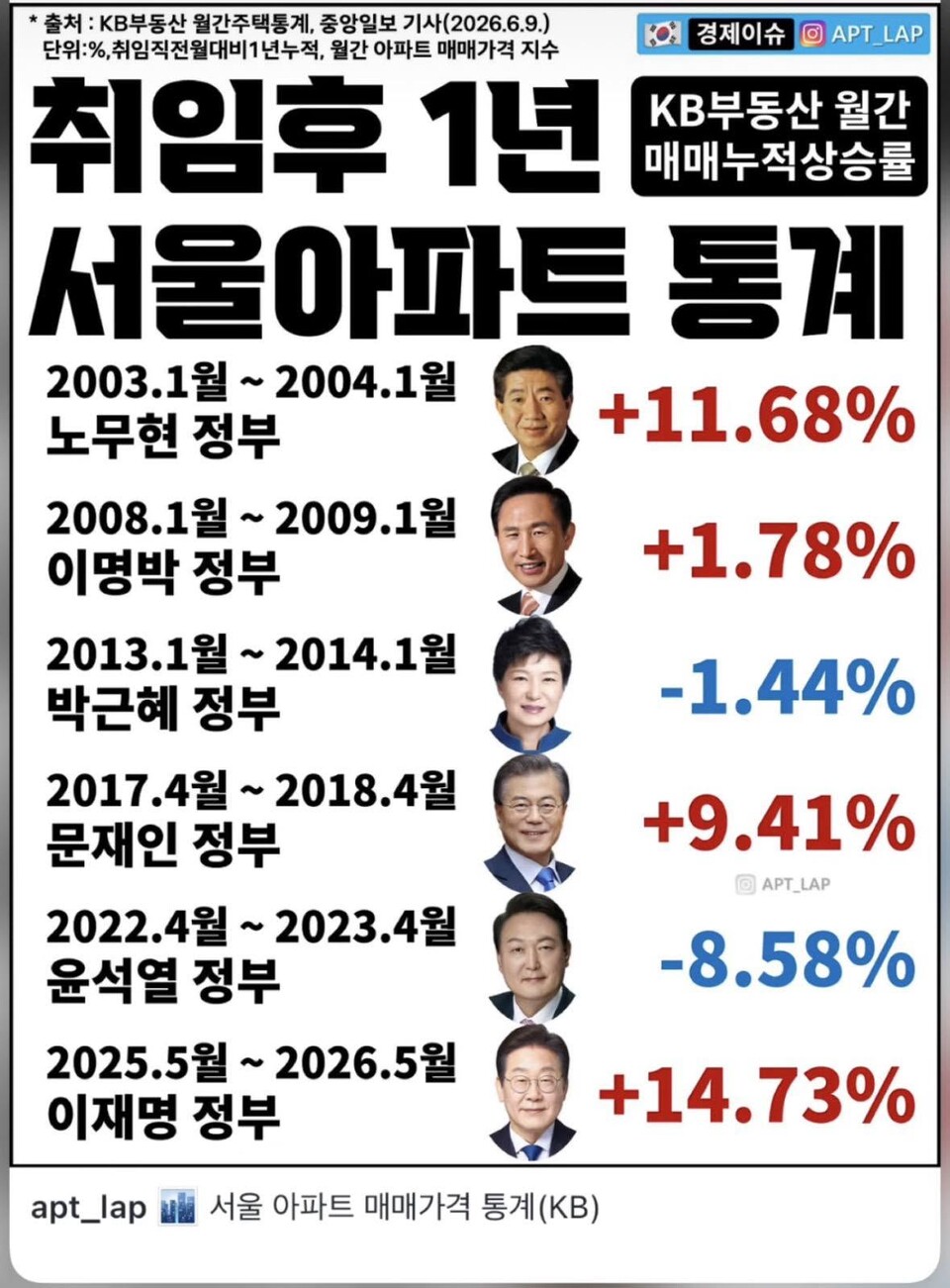
South Korea's housing market in 2026 presents one of the most striking paradoxes in global real estate: a government deploying its most aggressive demand-suppression toolkit in decades — transaction zone restrictions, loan-to-value caps, punitive capital gains taxes — while apartment prices in Seoul and the surrounding metropolitan area continue to set all-time records. According to KB Real Estate data, Seoul apartment prices rose +14.73% in the twelve months following the Lee Jae-myung administration's inauguration in May 2025. That figure is not just high by recent standards — it is the largest first-year gain of any Korean presidential administration in the modern era. Understanding why this is happening, and why it is likely to continue, requires looking beyond the policy headlines to the structural realities that no regulation can quickly fix.
The Historical Record: First-Year Performance by Administration
The most compelling data point for understanding Korea's current housing trajectory is a direct comparison of Seoul apartment price performance in the first year of each presidential administration since 2003, using KB Real Estate's monthly housing price index. The numbers tell a clear story.
| Administration | Period | 1-Year Seoul Apt. Price Change | Policy Orientation |
|---|---|---|---|
| Roh Moo-hyun (노무현) | Jan 2003 – Jan 2004 | +11.68% | Demand controls introduced |
| Lee Myung-bak (이명박) | Jan 2008 – Jan 2009 | +1.78% | Global financial crisis impact |
| Park Geun-hye (박근혜) | Jan 2013 – Jan 2014 | -1.44% | Post-bubble correction |
| Moon Jae-in (문재인) | Apr 2017 – Apr 2018 | +9.41% | Aggressive demand suppression |
| Yoon Suk-yeol (윤석열) | Apr 2022 – Apr 2023 | -8.58% | Rate hikes + post-bubble correction |
| Lee Jae-myung (이재명) | May 2025 – May 2026 | +14.73% | Demand controls + supply shortage |
Source: KB Real Estate Monthly Housing Statistics (KB부동산 월간주택통계); Joongang Ilbo report June 9, 2026. Unit: cumulative 12-month change in monthly apartment transaction price index, Seoul.
The +14.73% recorded under the Lee administration's first year is not merely the highest since the Moon administration's peak years — it is the highest first-year gain of any administration in this dataset. It exceeds the Roh Moo-hyun government's +11.68% by more than three percentage points, and it occurred despite a regulatory environment that is arguably more restrictive than any of its predecessors.
This comparison is not merely of historical interest. Research on Korean housing cycles and international comparisons of supply-constrained urban markets consistently shows that first-year administration price performance is positively correlated with medium-term price trends. Administrations that begin with strong appreciation tend to sustain elevated appreciation through the remainder of their terms, absent a significant demand shock or supply surge. Neither appears likely in Korea's near term.
The Fundamental Problem: Seoul Is Running Out of Housing Supply
The most important number in Korean real estate right now is not the price index. It is the housing completion forecast for 2025 through 2028. Across the Seoul metropolitan area — home to approximately half of South Korea's 51 million people — new apartment completions are projected to fall to their lowest levels in over a decade. The Korea Research Institute for Human Settlements and multiple private research firms estimate that annual completions in greater Seoul will drop to roughly 70,000–80,000 units per year through 2027, compared to the 120,000–150,000 units needed to meet annual household formation and replacement demand.
This supply gap did not materialize overnight. It is the compounded result of three factors that have been building since 2019. First, land acquisition costs in Seoul and the surrounding metropolitan area have made new development economically marginal even at high sale prices, particularly for the mid-range apartments that constitute the majority of housing demand. Second, the regulatory approvals process for large-scale redevelopment projects — the remodeling and reconstruction of aging apartment complexes that makes up the dominant supply pathway in a city where greenfield development is essentially exhausted — has become significantly longer and more uncertain. Third, the sharp rise in construction costs following global supply chain disruptions and domestic labor cost increases has caused developers to delay or cancel projects that were financially viable in 2020 but are not today.
The pipeline data is stark. Projects completing in 2026 and 2027 were primarily permitted in 2022 and 2023 — a period when new development filings in Seoul fell sharply. Even an emergency approval process beginning today would not produce finished apartments before 2028 at the earliest, given the 3–4 year timeline from permit to completion that characterizes large Seoul residential developments. The supply shortage is, in the most literal sense, locked in for the next several years regardless of any policy action.
The Polarization Between Seoul and the Regions
One of the defining features of Korea's 2026 housing market is the widening divergence between Seoul and non-metropolitan Korea. While Seoul apartment prices have risen sharply, prices in many regional cities — particularly the former heavy industrial centers of the southeast coast and smaller cities across the Chungcheong and Jeolla provinces — have stagnated or declined. In some areas, apartment vacancy rates have reached levels that would qualify as distress by any reasonable measure.
This polarization reflects fundamental demographic and economic forces that predate the current government. Korea's population is declining — the total fertility rate has fallen to approximately 0.72, the lowest among OECD nations — and the population that remains is concentrating in Seoul and a handful of satellite cities at an accelerating rate. Young Koreans in particular are migrating to the capital region for employment, education, and cultural opportunity in numbers that consistently exceed planning projections. The result is a housing market that looks dramatically different depending on the postcode: acute shortage and rising prices in the capital region, chronic oversupply and stagnation in the periphery.
For policymakers, this polarization creates a structural problem. Policy tools calibrated to cool the Seoul market apply nationally but do not address the distinct problems of regional markets. In some cases, national demand-suppression policies have compounded the difficulties of regional markets by reducing transaction volumes across the board, making it harder for struggling regional developers to sell completed inventory.
The Government's Toolkit: What It Has Done and What It Has Not
The current Korean government's approach to housing has been the most interventionist in recent memory. The flagship policy is the toheoje (토허제, transaction permit zone system), which requires government approval for apartment purchases in designated high-speculation areas — effectively Seoul's most sought-after districts. Buyers in these zones must demonstrate that they will occupy the property themselves, that they do not own other homes, and that their purchase financing meets strict standards.
Accompanying the transaction permit system are loan-to-value ratio caps that have been progressively tightened. In the strongest regulated zones, mortgage financing is now limited to 30–40% of the purchase price for buyers who already own property, effectively requiring substantial cash equity that prices out most middle-income buyers. Capital gains tax rates on short-term property sales have been increased to levels that would eliminate most speculative profit on holds under two years. The comprehensive real estate holding tax (종합부동산세) has been applied to multi-home owners at rates designed to make holding multiple properties economically unattractive.
These policies have had measurable effects — on transaction volumes. Apartment trading in Seoul's regulated zones fell significantly following the implementation of the strictest controls. But prices have continued to rise even as turnover has fallen, a phenomenon characteristic of genuine supply-constrained markets: when buyers outnumber available units and sellers have no urgency to transact, restricting buyers primarily restricts supply further rather than reducing prices.
Rent Prices Rising in Tandem: The Jeonse and Monthly Rent Crisis
Perhaps the most telling indicator of Seoul's housing fundamentals is the behavior of the jeonse market. Jeonse — Korea's unique lump-sum deposit rental system — serves as a real-time indicator of housing supply and demand that is difficult to manipulate through ownership-focused regulation. When potential buyers are blocked from purchasing by loan restrictions, they remain in the rental market longer, increasing demand for jeonse deposits. When existing jeonse tenants face renewal, landlords — aware that replacement tenants are plentiful — have been raising deposit requirements at the strongest pace since 2021.
Monthly rent (월세) has followed the same trajectory. The proportion of rental contracts structured as monthly rent rather than jeonse has increased as higher interest rates have made jeonse less financially attractive for landlords, and the resulting shift has pushed monthly rents upward in a market where rental supply has not kept pace with demand. The simultaneous rise of both purchase prices and rental costs is the market's clearest signal that the shortage is real and supply-side in origin — demand controls that cannot increase housing units cannot ultimately prevent this dynamic.
Why the Record First-Year Gain Predicts a Historic Bull Run
The +14.73% first-year gain under the Lee Jae-myung administration is the starting point for a medium-term projection, not the endpoint. Three structural conditions suggest that appreciation at or above historical norms is the base case for the remainder of the current presidential term through 2027.
First, the supply shortfall described above is not addressable within the current government's term regardless of policy changes announced today. The shortage driving prices in 2026 will still be driving prices in 2028. Second, demand fundamentals remain strong — employment in the Seoul metropolitan area continues to grow in sectors that disproportionately locate in the capital, sustaining the wage premium that drives migration. Third, Korean households continue to treat housing as the primary wealth-building asset class, a cultural preference that government taxation and regulatory policy has repeatedly failed to redirect.
The demand-suppression policies currently in effect have, paradoxically, created an additional price pressure mechanism. By restricting transactions, the policies have reduced the effective supply of units available for purchase — not by reducing the number of units that exist, but by reducing the number that owners are willing to sell given tax consequences. This "lock-in effect" is well-documented in supply-constrained housing markets: high transaction taxes cause potential sellers to hold rather than transact, reducing market liquidity and creating upward price pressure as limited available supply serves elevated demand.
If the current administration's first-year gain of +14.73% is followed by additional appreciation at even half that annual rate through 2027, the cumulative price increase over the full presidential term would approach or exceed the total gains recorded under any previous administration — making the Lee Jae-myung government's tenure potentially the most significant housing price event in modern Korean economic history.
Implications for Buyers, Sellers, and Renters
For prospective buyers in the Seoul metropolitan area, the analytical framework above suggests that waiting for a price correction driven by government policy is a strategy with poor historical support. No Korean administration's demand-suppression toolkit has produced a sustained price decline in the Seoul market during a period of supply shortage. The practical question for buyers is not whether prices will fall but whether the financing and regulatory environment makes purchase feasible within the toheoje framework.
For renters, the outlook is for continued upward pressure on both jeonse deposits and monthly rents, particularly in sub-markets closest to major employment centers in Gangnam, Yeouido, and the technology corridors of the northeastern metropolitan area. Renters who can lock in multi-year jeonse contracts at current rates may find that option preferable to shorter-term monthly arrangements in a rising rent environment.
For regional property owners and investors, the divergence between Seoul and non-metropolitan Korea underscores the importance of location specificity. The bullish structural case for Seoul does not extend uniformly to the rest of the country — and in some regional markets, the outlook is for continued stagnation or gradual decline as demographic contraction outpaces any demand stimulus.
Bottom Line: KB Real Estate data shows Seoul apartment prices rose +14.73% in the Lee Jae-myung administration's first year — the largest first-year gain of any Korean presidential administration on record, exceeding the Roh Moo-hyun government's +11.68% in 2003–2004 and the Moon Jae-in government's +9.41% in 2017–2018. This gain occurred despite the most aggressive demand-suppression toolkit in recent Korean policy history: toheoje transaction controls, tightened LTV caps, and elevated holding taxes. The reason is structural: a supply shortage locked in through at least 2027–2028 by a depleted construction pipeline, set against sustained demand from Seoul's dominant economic position. Purchase prices and rental prices are rising in tandem — the classic signature of a supply-constrained market. If historical patterns connecting first-year performance to medium-term trends hold, the remainder of this presidential term could see aggregate housing gains that exceed any previous administration in the modern era.

![Seoul Neighborhoods for Property Buyers [2026]: Beyond Gangnam](/img/posts/fix-seoul-neighborhoods-honest-guide-20-8a3f9c2d.jpg)
![Chickens [2026]: 7 Things Nobody Tells You Before Getting Backyard Hens](/img/posts/fix-jeonse-vs-wolse-honest-2026-4cae8b0b.jpg)
![Reptile Care [2026]: 7 Things New Owners Get Wrong in the First Month](/img/posts/fix-korea-real-estate-honest-2026-c97fcb5b.jpg)
![Korea's Toltol Han Chae Phenomenon [2026]](/img/posts/toltol-han-chae.jpg)